
Harness the power of advanced Artificial Intelligence (AI) to easily create personalized, insightful, and empathetic responses to reviews.
AI Responder
AI Smart Response Templates
How AI Responder Works
AI Responding is designed to revolutionize how your business interacts with customer reviews. Say goodbye to generic and time-consuming replies! With AI Responding, your team gains a valuable ally that can analyze sentiments, understand nuances, and tailor responses to meet individual needs. This game-changing feature saves your team time and allows them to focus on building stronger relationships with customers.
Users can leverage AI to generate responses for reviews from public review sources that have customer comments as opposed to just a star rating.
If the review is eligible for AI Responding, click the “Generate AI Response” button. This will take in the review content and the AI Rules prompt and suggest a response based on that input.

Things to Note
- Users can generate up to 5 AI responses per review per hour based on our rate limit.
- Users are provided with a default prompt that they can edit to refine their response suggestions. This can be modified by clicking the “Edit AI Rules” button.
- The AI rules are saved at the user level, so modifying the prompt will not impact any other users.
- Users can reset the AI rules back to the default we provide at any time
- Users cannot leverage AI responding for public review sources that are rating-only and do not contain any text content.
- Why? When there is no review text to provide, generative AI cannot suggest accurate, relative responses.
- Users will also not be able to use AI Responding for 1st party imports nor Feedback sources.
- Why? This could infringe on the privacy rights of those submitting their feedback for internal purposes only.
- For reviews that are ineligible for AI Responding, we fall back to our Response Generator tool
What to Expect
While AI-generated responses take into context the review content and prompt content, this input is simply a request and not a demand. Generative AI will sometimes get it wrong. There is no foolproof way to create a prompt so good that the responses will always be ideal, and it is always recommended that customers proofread the entire response suggestion before posting.
Tips for Editing AI Rules

The default prompt is designed to work with reviews from all industries, but users should feel free to edit it to address any of their specific needs, and the option to reset back to our default is always available. It should be emphasized that no prompt will ever suggest review responses that are accurate 100% of the time, but as long as the suggested responses are mostly correct, this tool should be of value.
Some Things You Can Do with AI Rules
- Change the Tone

- Add a signature
- Include On-Brand Vernacular


- Encourage Vocabulary Variation
- If you notice suggested responses use the same vocabulary words repeatedly, you can encourage variation by including stop-words in your prompt.
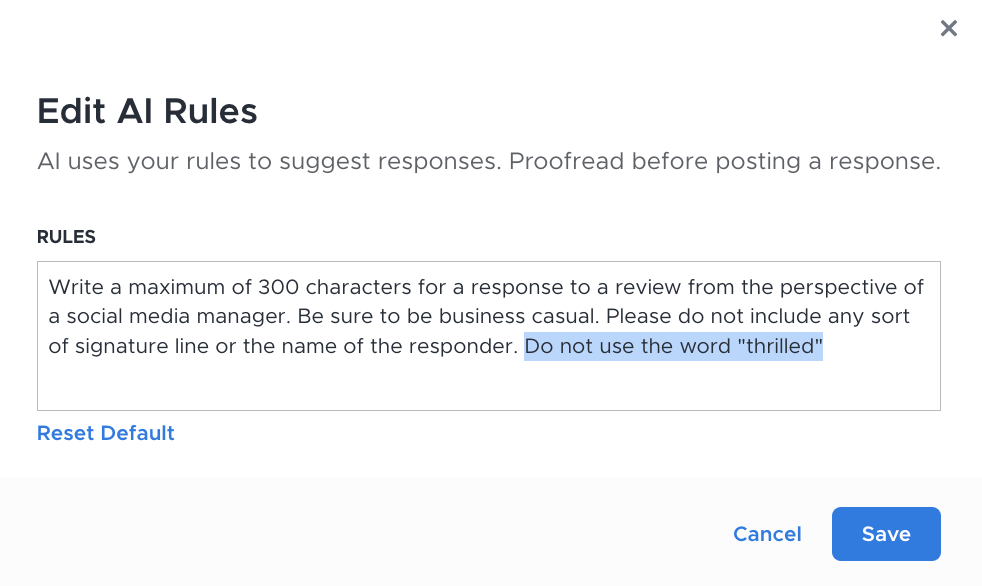
- Exclude Apologies or Admissions of Wrong-doing

AI Auto Response Templates
With AI Auto Response Templates, easily create and save personalized, on-brand review response prompts for your team, enabling faster and more engaging customer interactions. Use them in auto-responding workflows or as a library of pre-approved templates your team can choose from when responding to reviews.
Why should I use it?
- Maximize impact and reduce workload: Set response parameters, improving review response rates and time without sacrificing quality or control.
- Smart, adaptive responses at scale: Forget endless template writing and one-size-fits-all replies.
- Engage your diverse customer base: Deliver dynamic, localized responses in either English or the review’s original language.
How To’s
Creating a Template
- Visit Settings → Response Templates & Review Status → Add Response Template → AI Response Template.
- The default text provided in the template will be carried over from whatever the default is in AI Rules.
- You can learn how to edit the AI rules in this article Advanced AI Responding
- Edit the text as desired. If, at any point, you decide you want to restart your writing, clicking ‘Reset Default’ will bring back the original default text
- Select the ‘Review Type’ the template will apply to. Options are:
- Positive - Rating with Content
- Negative - Rating with Content
- Positive - Rating Only
- Negative - Rating Only
- Once a Review Type has been selected, you have the option to select specific ratings within the Review Type, for example, if Negative - Rating with Content is selected, you can choose to assign to just 1-star reviews, 1 and 2-star reviews, etc.
- Under the ‘Responding’ section, you can decide whether you want the review response to be written in either English or the language the review was written in. How this works:
- Let's say you are a company that has locations based in Miami, where Spanish is almost as common as English, and it would be appropriate to respond to a Spanish review in Spanish, instead of English
- You can create an AI Response Template scoped to these Miami locations and select “respond to reviews in their written language," assuming that many of the reviews will be in Spanish
- When Spanish reviews come in, even if you have language translations on, the response from this AI template will be in Spanish for those reviews
- However, if a review were to come in for one of these Miami locations that was written in German, the response will be in German because you have this box checked
- If the box is not checked, the responses will always be in English
- Checking the ‘Auto-Respond’ box will enter this template into circulation for use on reviews from integrated sources that can receive responses. How this works:
- If auto-responding is checked, the response template will be entered into circulation with all other response templates that match the review criteria. This includes standard response templates and not just AI Response Templates
- Customers can assign the template to all groups and locations or select groups and locations.
Previewing & Adding a Template
- Once you’ve filled out all the required fields for creating the template, you can preview it by clicking the ‘Add’ button.
- The response preview will select a random review of yours that matches the criteria of the template to demonstrate how the template you’ve created will perform on your reviews. If no reviews match the criteria, an example review will be provided. The fields that can be referenced in the template are the following:
- Review content
- Review rating
- Author name (full or first name)
- Location name
- You can regenerate the response up to 10 times per hour for each review to see how it may vary. If you are unsatisfied with how it performs, you can opt to 'Keep Editing'.
- Once you are satisfied with the response, clicking ‘Add’ will activate it and make it available for use.
Viewing & Managing Response Templates
- You can view all of your AI Response Templates in the same table as your existing response templates. A purple tag will indicate those AI ones.
- You can also filter down to view just the AI Response templates and not the standard templates.
Tips for Creating a Successful Prompt
Context
You are using the AI model to respond to online reviews for your business, so don’t forget to mention that. When crafting a prompt, specific context is always helpful to ensure the accuracy of the response. Here are some you might try:
- “Respond to this online review for a business.”
- “Write a response to this review for a business”
Addressing the Reviewer
Do you want to address your reviewer by first name? First and last name? Or are you worried that the reviewer's name might be fake and want to leave it out entirely? You can do so by offering the model guidance on how to handle names. Here are some examples:
- “Address the reviewer by first name only.”
- “Always address the reviewer by first and last name.”
- “Never mention the name of the reviewer in the response.”
- “If the reviewer's name sounds like a real name, address the reviewer by first name; if not, do not address the reviewer by name.”
Tone
Are you going for casual and friendly? Professional and stoic? Something in between? Providing the prompt with instructions on tone helps ensure AI responses communicate in the voice of your brand. Some examples:
- Healthcare Org: professional and sincere
- Fast Casual Restaurant: fun and friendly
- Financial Services Company: business casual
Perspective
Similar to the tone of response, instructing the prompt to write from the business's perspective often helps get the tone right. For example:
- “Respond from the perspective of a social media manager for a credit union.”
- “Respond from the perspective of a patient coordinator and a national healthcare organization.”
- “Respond from the perspective of the location manager at a local restaurant chain.”
Length
Don’t want to model to write too much or too little? Give it some instructions on the length of the response. You can try things like:
- “In under 500 characters or less”
- “In under 50 words”
- “Be concise.”
- “Don’t be too short on length.”
Content
Give the prompt specific instructions on things you want to include in the response, as well as what to avoid.
- “Do not apologize or admit guilt, but let them know we take the matter seriously.”
- “Refer to the reviewer as a ‘member’ instead of a ‘customer’”
- “Always sign on with ‘Dan Hayden, Regional Manager’ and include the signature on a new line.”
Word Exclusion
Generative AI models tend to overuse certain words based on the data the LLM was trained on. If you notice that certain words keep coming up too often, you can instruct the prompt to leave them out. For example:
- “Don’t use the word ‘thrilled’”
Putting it All Together
Let's take a look at how some of these prompts look in action:
- “Respond to this online review for a business in a fun and friendly tone from the perspective of the location manager at a local restaurant chain in under 50 words. Always sign on with ‘Dan Hayden, Regional Manager’ and include the signature on a new line.”
- “Write a response to this review for a business from the perspective of a patient coordinator and a national healthcare organization. Do not apologize or admit guilt, but let them know we take the matter seriously.”
FAQs
Who will have access to AI Auto Responding?
All Admins for accounts that have response tools enabled.
- Only Admins can create AI Response Templates
- Non-admins ie. managers and other users with responding capabilities, will be able to use these templates to respond in-app.
- Non-admins cannot create the templates or set them to auto-respond.
Who shouldn’t use it?
We don’t recommend this tool for the healthcare industry due to the high levels of regulation.
Is using AI to auto-respond to reviews risky?
The AI responds to reviews based on the rules your brand sets, and you are 100% in control of that. You can also preview a response before saving a prompt for added safety.
What value does it bring?
- Free your team to focus on strategy and let AI take care of engagement, improving review response rates and time without sacrificing quality or control.
- Eliminate the need for endless template writing and approvals by crafting unlimited responses that align with your guidelines, ensuring consistency, authenticity, and efficiency.
- Build authentic connections with your diverse customer base while maintaining a consistent brand voice by delivering localized responses in either English or the review’s original language.
- From marketing leaders to branch managers, many roles organization wide can utilize this to save time and enhance customer engagement.
Please reach out to support@reviewtrackers.com if you have any additional questions about this feature and our team will be happy to assist!